

Managing multiple social media accounts without proxies can lead to account bans, login issues, and restricted access. Social media platforms monitor IP addresses and activity patterns to detect unusual behavior, which can result in CAPTCHAs, rate limits, or account suspensions. Here's how proxies solve these problems:
- Avoid IP Detection: Proxies assign a unique IP to each account, preventing platforms from linking them.
- Bypass Geo-Restrictions: Access region-specific content or features by routing traffic through proxies in target locations.
- Minimize Account Bans: Reduce the risk of accounts being flagged by spreading activity across multiple IPs.
- Support Automation: Proxies work with tools to manage posting, engagement, and analysis without triggering platform limits.
Key Proxy Types:
- Datacenter Proxies: Fast and affordable but easier to detect.
- Residential Proxies: Use real IPs from ISPs, offering higher trust and lower detection risks.
- ISP Proxies: Combine speed and reliability, ideal for stable, long-term account management.
Proxies are critical for managing multiple accounts securely, especially for businesses and agencies. Choose high-quality proxies, match IPs to account locations, and monitor performance to ensure smooth operations.
Why Proxies Are Necessary for Multiple Social Media Accounts
How Platforms Track IPs and Detect Suspicious Activity
Social media platforms are constantly on the lookout for unusual activity, and they rely on a combination of IP addresses, device fingerprints, browser data, and cookies to track user behavior. These tools help platforms identify how many accounts and actions are tied to a single network identity. Advanced machine-learning systems scan for patterns like rapid account creation, repetitive posting, or identical content across multiple profiles. Activities that don’t align with typical human behavior, such as frequent logins or simultaneous actions across accounts, are quick to raise red flags.
If a large number of accounts are created or managed from the same IP address in a short period, platforms often interpret this as a sign of spam, bot activity, or account farming. Actions like rapid switching between accounts, mass posting, or logging in from different locations within a short timeframe can trigger automated risk systems. This can be especially problematic for U.S.-based businesses or agencies managing dozens of accounts from a single office IP, as they can easily cross these detection thresholds.
Platforms like Facebook and Instagram use powerful AI and anti-spam technologies to detect suspicious behavior. For example, Facebook employs deep learning to identify fake or centrally managed accounts, while Instagram frequently flags multiple accounts on the same IP, often leading to IP bans that are challenging to reverse. Since platforms typically limit the number of accounts that can operate from a single IP, going beyond these limits can result in blocks, freezes, or verification requests. For anyone managing more than five Instagram accounts, proxies become a must-have tool to prevent account disruptions.
The Risks of Account Bans and Suspensions
Sharing an IP address across multiple accounts can lead to various problems, including CAPTCHAs, SMS or email verifications, and strict action limits. In more severe cases, platforms may freeze or permanently ban accounts associated with suspicious IP activity.
When multiple accounts operate under the same IP, platforms may assume they are part of a bot network or fake account farm. This can result in account locks, permanent suspensions, or even an IP-wide ban that affects all linked accounts. For businesses that rely on social media for marketing, customer service, or ad campaigns, these bans can cause significant disruptions. Lost access to accounts can lead to halted campaigns, reduced revenue, and damage to the company’s reputation.
Because detection systems often struggle to distinguish between legitimate multi-account management and harmful bot activity, they tend to err on the side of caution. This means aggressive blocking policies are often applied, placing legitimate users at risk of losing access to their accounts. Proxies, therefore, play a critical role in mitigating these risks and ensuring smooth account management.
How Proxies Work for Social Media Management
Proxies Route Traffic Through Alternate IP Addresses
When you connect to a social media platform using a proxy, the platform only detects the proxy's IP address - not your own. Essentially, the proxy acts as an intermediary, handling your logins, posts, and other requests, then forwarding them using its IP. You simply configure your browser or social media management tool with the proxy's IP and port, and the proxy takes care of relaying the platform's responses back to you. By assigning a separate proxy to each account, each profile appears to originate from a unique device and location. This setup not only masks your real location but also creates a layer of separation that helps manage multiple accounts securely.
How Proxies Reduce Detection and Protect User Data
Beyond rerouting traffic, proxies play a key role in protecting user data and reducing detection risks. Social media platforms often flag repeated logins or high activity levels from the same IP address. Proxies counter this by spreading account activity across multiple IPs, ensuring no single address handles too many profiles. Residential and ISP proxies, in particular, simulate everyday user connections, helping avoid security alerts. On top of that, proxies act as a shield between your device and the platform, hiding your true IP and making it harder for platforms or malicious actors to trace your activity back to your physical location. For agencies managing multiple accounts, this approach minimizes the chances of triggering platform restrictions while keeping sensitive data secure.
If you're considering these strategies, premium providers like BirdProxies offer dedicated ISP, residential, and datacenter proxy options tailored for secure and effective social media management.
How to manage multiple Facebook accounts using proxies | Facebook proxy
Types of Proxies for Social Media Account Management
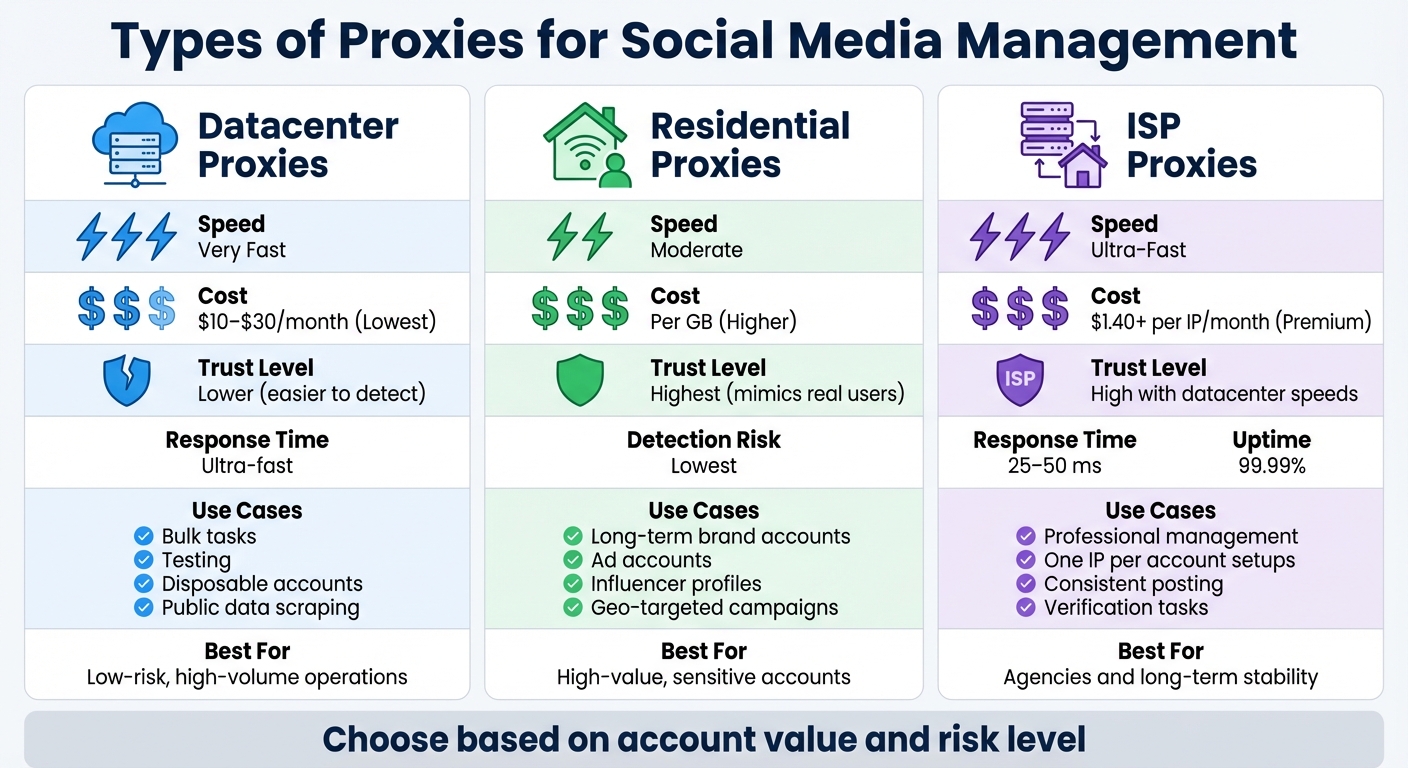
Comparison of Datacenter, Residential, and ISP Proxies for Social Media Management
Datacenter Proxies
Datacenter proxies operate through cloud servers, independent of consumer internet service providers (ISPs). They are known for their high speed and affordability, making them a go-to choice for managing social media accounts at scale. These proxies are particularly effective for bulk activities like scraping public data, running tests, or verifying account credentials. However, they come with a trade-off: datacenter IPs are easier to detect since they share ASN ranges and exhibit non-residential traffic patterns. If you're working with low-risk or disposable accounts and need to prioritize speed and cost, datacenter proxies offer a budget-friendly option, with prices starting as low as $10–$30 per month. While they shine in low-stakes scenarios, residential proxies are better suited for managing accounts requiring higher authenticity to avoid detection.
Residential Proxies
Residential proxies address the limitations of datacenter proxies by using IP addresses assigned by consumer ISPs to actual households. This setup allows them to mimic regular user traffic, resulting in higher trust scores, fewer CAPTCHAs, and a much lower risk of bans - especially on platforms like Facebook, Instagram, and TikTok, which have strict detection systems. These proxies are an excellent choice for managing high-value, long-term accounts such as brand pages, ad accounts, or profiles belonging to influencers. Because residential proxies originate from real home networks, they allow platforms to verify location details like country, city, and ISP, making them ideal for geo-specific campaigns. Although they are slower and typically more expensive (priced per gigabyte), their ability to bypass detection makes them indispensable for sensitive account management.
ISP Proxies
ISP proxies strike a balance between the speed of datacenter proxies and the authenticity of residential proxies. These proxies use real ISP-assigned IPs but are delivered from data centers, offering stable and fast connections (25–50 ms response times) while maintaining residential-like trust levels. They are perfect for tasks requiring long session stability, such as consistent content posting or one-IP-per-account setups. This makes them a favorite among professional social media managers and agencies juggling multiple accounts. While ISP proxies come with a higher price tag compared to datacenter options, their reliability in preventing detection and ensuring account safety justifies the cost. Providers like BirdProxies offer ISP proxies starting at $1.40 per IP per month, featuring 99.99% uptime and unlimited bandwidth.
| Proxy Type | Speed & Cost | Trust Level | Use Case |
|---|---|---|---|
| Datacenter | Very fast; lowest cost ($10–$30/month) | Lower trust; easier to detect | Bulk tasks, testing, disposable accounts, public data scraping |
| Residential | Moderate speed; higher cost (typically per GB) | Highest trust; mimics genuine user behavior | Long-term brand and ad accounts, automation, geo-targeted campaigns |
| ISP/Static | Ultra-fast (25–50 ms); premium pricing | High trust with datacenter speeds | Professional management; one IP per account setups; verification tasks |
sbb-itb-ea6392c
How to Set Up Proxies for Multiple Accounts
Building on the role of proxies in reducing detection, a proper setup is essential for securely managing multiple accounts.
Choosing the Right Proxy Type
The type of proxy you choose depends on the value and risk level of your accounts. For high-value accounts - like brand pages, monetized profiles, or those with a large follower base - ISP proxies with static IPs are ideal. These proxies offer stability and lower block rates, helping to establish trust with social media platforms. For mid-tier accounts that post regularly and interact often, rotating residential proxies with sticky sessions provide a good balance between anonymity and consistency. On the other hand, if you're handling bulk tasks like market research or testing, datacenter proxies are a cost-effective and fast option.
A critical rule: use one proxy per account. Sharing a single IP address across more than five accounts can trigger platform security systems, potentially leading to account bans. These bans are often challenging to reverse, so it's better to err on the side of caution.
Once you've chosen your proxies, configure your setup to imitate natural user behavior.
Setting Up IP Rotation and Session Management
After selecting the right proxy, managing IP rotation and sessions is key to staying under the radar. For rotating proxies, configure them to mimic natural user activity. For example, set rotations to occur in patterns that align with typical human behavior. For important accounts, use sticky sessions to maintain the same IP address for several hours or even days, as this closely resembles how real users connect from home or work networks.
Many tools, such as Multilogin, Gologin, Jarvee, and Hootsuite, support proxy integration. Assign each account its own dedicated proxy to avoid suspicious activity like mid-session IP changes, which could raise red flags.
Once everything is set up, testing and monitoring become critical steps to ensure smooth operation.
Testing and Monitoring Proxy Performance
Before deploying proxies, test them thoroughly. Check that the IPs are clean, have low latency, and match the correct geo-location. Perform test logins to confirm there are no issues like CAPTCHAs or two-factor authentication (2FA) blocks.
Keep an eye on performance using real-time dashboards. Monitor metrics like block rates, latency, and uptime. Replace any proxies that show issues immediately. Setting up alerts can also help you respond quickly if a proxy starts causing problems or if accounts receive security warnings. Providers such as BirdProxies offer tools with real-time analytics and guaranteed uptime, making it easier to track performance and maintain stable connections for your accounts.
Benefits of Using Proxies for Social Media Management
Once your proxies are set up and running smoothly, the advantages quickly become apparent: better security, unrestricted access, and streamlined automation.
Bypassing Login Limits and Geo-Restrictions
Social media platforms often limit how many accounts or actions can come from a single IP address, flagging excessive activity as suspicious. For instance, Instagram might detect multiple accounts from the same IP as spam, which could lead to bans that are tough to undo. Proxies solve this by routing each account through a unique IP, spreading out logins and actions across different addresses to stay under platform thresholds.
Proxies also make it possible to access region-specific content and campaigns. Assigning a profile a proxy from the target country allows posts and ads to be displayed exactly as local users would see them. Using high-quality residential or ISP proxies can reduce issues like geo-blocking and rate limits since they mimic trusted, everyday user connections. These benefits not only bypass platform restrictions but also help enhance account security.
Preventing IP Bans and Protecting Privacy
Managing too many profiles from a single IP can lead to account blocks. Proxies protect against this by hiding your real IP and only exposing the proxy's IP and location. This keeps your actual network details and physical location private. This layer of security is especially important for tasks like monitoring negative campaigns, analyzing competitors, or handling high-profile client accounts. Providers like BirdProxies offer clean IP ranges with strong trust scores and low detection rates, helping to maintain privacy and avoid platform flags. By reducing bans and safeguarding privacy, proxies create a stable environment for managing accounts and automating processes.
Supporting Automation and Location-Specific Access
Automation tools often make a high number of requests, which can quickly hit platform rate limits if they all come from a single IP. Pairing these tools with rotating or distributed proxies makes the traffic look like it’s coming from multiple regular users instead of one aggressive script. Stable ISP or static residential proxies work well for consistent tasks like daily posting, while high-rotation proxies are better for burst activities like scraping or analytics. Region-specific proxies also allow managers to test localized content and verify geo-targeted ads across various markets. Providers like BirdProxies simplify this process by offering proxies from multiple locations and API access for smooth integration with automation tools, making location-based management easier than ever.
Best Practices for Safe and Effective Proxy Use
Even the most advanced proxy setups require disciplined practices to work effectively. By mirroring natural user behavior, protecting key accounts, and keeping a close eye on performance, you can ensure your proxy strategy remains both efficient and secure.
Keeping Account Activity Patterns Consistent
Platforms like social media monitor user behavior to identify "normal" patterns, such as login times, activity levels, and location consistency. Sudden changes - like logging in from a different region or spiking activity - can set off security alarms. To avoid this, assign each account to a single geographic IP and stick to regular login hours, for instance, 8 a.m. to 6 p.m. local time on weekdays.
New accounts require a gradual "warm-up" period. Start with modest actions - say, 20–40 follows and 30–60 likes per day - and increase activity slowly over time. Avoid drastic shifts, such as jumping from manual posting to heavy automation overnight or suddenly posting 24/7 after maintaining a weekday-only schedule. Spread out actions with short delays, and ensure device fingerprints (like browser type, user-agent, and time zone) match the proxy's location. This creates the impression of a real person managing the account.
Using Dedicated IPs for Important Accounts
Consistency isn't just about behavior - it extends to IP addresses as well. For high-priority accounts, always use dedicated IPs. Shared or rotating IPs can expose your accounts to risks caused by other users' spammy activities, leading to captchas, login challenges, or even bans. Dedicated IPs ensure that only your actions influence the IP's reputation.
These IPs also provide a stable "home" for accounts, which platforms recognize over time, reducing the likelihood of triggering fraud detection systems. For example, if you're managing several flagship accounts for a U.S. brand, assigning each a clean, dedicated IP ensures that issues with one account won't spill over to others. Premium static residential or ISP proxies are ideal for this purpose, offering stability and trustworthiness. While these proxies may cost more, the investment is worthwhile when losing an account could mean lost audiences, ad spend, or damage to your brand's reputation.
Rotating Proxies and Monitoring Performance Regularly
For high-volume tasks, such as scraping data, tracking competitors, or testing geo-targeted ads, rotating proxies can be a lifesaver. Rotating IP pools or timed rotations (e.g., switching every few minutes) help distribute requests across multiple addresses, reducing the risk of rate limits and bans.
Keep a close eye on performance metrics like CAPTCHA frequency, error rates, and connection issues. Track key indicators such as HTTP status codes (e.g., 429 errors), connection speeds, and response times to ensure everything runs smoothly. Many proxy services, like BirdProxies, offer dashboards with real-time analytics. These tools allow you to spot underperforming subnets or locations and quickly reassign critical accounts to cleaner IPs. Maintaining detailed logs of proxy assignments can also help troubleshoot bans and fine-tune your setup for better results.
Conclusion
Running multiple social media accounts without proxies puts your operations at risk. Platform restrictions can kick in quickly, disrupting your workflow. Proxies solve this by assigning unique IPs to each account, improving security, reducing login problems, and making account management much smoother. Essentially, clean IPs help you avoid unnecessary friction, streamline processes, and focus on scaling without constant interruptions.
However, the success of this approach depends heavily on the quality of your proxy provider. Cheap or shared proxies often rely on overused IP ranges that platforms like Instagram and Facebook block almost instantly. These platforms use advanced anti-spam systems, so investing in premium proxies with dedicated, reliable IPs is essential for managing accounts professionally.
When choosing proxies, focus on a few key factors: opt for clean IPs with strong trust scores, select a mix of proxy types (like ISP proxies for high-priority accounts and rotating pools for automated tasks), and ensure the proxies match the geo-locations of your target audience. Dedicated IPs work best for flagship accounts, while rotating proxies handle bulk tasks effectively. Regularly monitor performance metrics, replacing any underperforming IPs to maintain smooth operations.
Start by assessing your account needs and testing a scalable proxy setup. Success indicators include fewer verification requests and consistent posting ability. By combining the right proxy strategy with disciplined management, you can turn multi-account social media management into a streamlined, scalable process rather than a constant challenge.
FAQs
How can proxies help prevent bans on social media accounts?
Proxies play a key role in preventing social media account bans by hiding your IP address. They make it look like each account is being accessed from a different location, which lowers the chances of being detected and avoids platform-imposed restrictions.
Rotating proxies take this a step further by frequently changing IP addresses. This mimics normal user behavior, making it harder for platforms to spot any unusual patterns that could flag accounts as suspicious. With proxies, managing multiple accounts becomes safer and helps you stay within platform rules.
What are the key differences between datacenter, residential, and ISP proxies?
Datacenter proxies are known for their lightning-fast speeds, making them perfect for handling tasks like bulk requests, large-scale API operations, and web scraping. Their low latency and ability to scale efficiently are key advantages. On the other hand, residential proxies use genuine household IP addresses, which makes them highly reliable for bypassing strict anti-bot measures and navigating geo-restrictions with ease. ISP proxies offer a blend of both worlds, combining the speed and reliability of datacenter proxies with the authenticity of residential proxies. They provide ultra-stable, static IPs with quick response times, making them ideal for high-frequency, persistent tasks.
Why should you use a separate proxy for each social media account?
Using a distinct proxy for every social media account is key to maintaining security and keeping your accounts active for the long haul. Social media platforms keep a close eye on IP addresses to spot anything unusual. If you manage multiple accounts from the same IP, it can raise red flags, potentially leading to account restrictions or bans.
When you assign a unique proxy to each account, it mimics the behavior of different users logging in from separate locations. This not only lowers the chances of your accounts being flagged but also helps ensure seamless and uninterrupted management of your social media activities.