

If you’re managing social media accounts, choosing between a VPN and proxies depends on your goals. Here’s the quick answer:
- VPNs encrypt all internet traffic on your device, offering privacy and security. They’re ideal for protecting sensitive data, using public Wi-Fi, or bypassing geo-restrictions. However, they can slow down your connection and are not well-suited for managing multiple accounts due to limited IP diversity and detection risks.
- Proxies mask your IP address for specific applications, allowing you to manage multiple accounts by assigning unique IPs. They’re faster, more scalable, and better for automation tasks, but most lack encryption, leaving your data vulnerable on unsecured networks.
Quick Comparison
| Feature | VPN | Proxy |
|---|---|---|
| Encryption | Yes (system-wide) | No (IP masking only) |
| Traffic Coverage | Device-wide | Application-specific |
| Speed | Slower (due to encryption) | Faster (no encryption overhead) |
| Best Use Case | Privacy, secure browsing | Multi-account management, automation |
| Detection Risk | Moderate (VPN IPs flagged) | Low (with residential/mobile IPs) |
| Typical Cost | $2–$12/month | $5–$15/month (basic); higher for advanced solutions |
Key Takeaway
Use a VPN for privacy and security. Opt for proxies when managing multiple social media accounts or performing automation tasks. Both have their strengths, but proxies are often the better choice for professional social media operations.
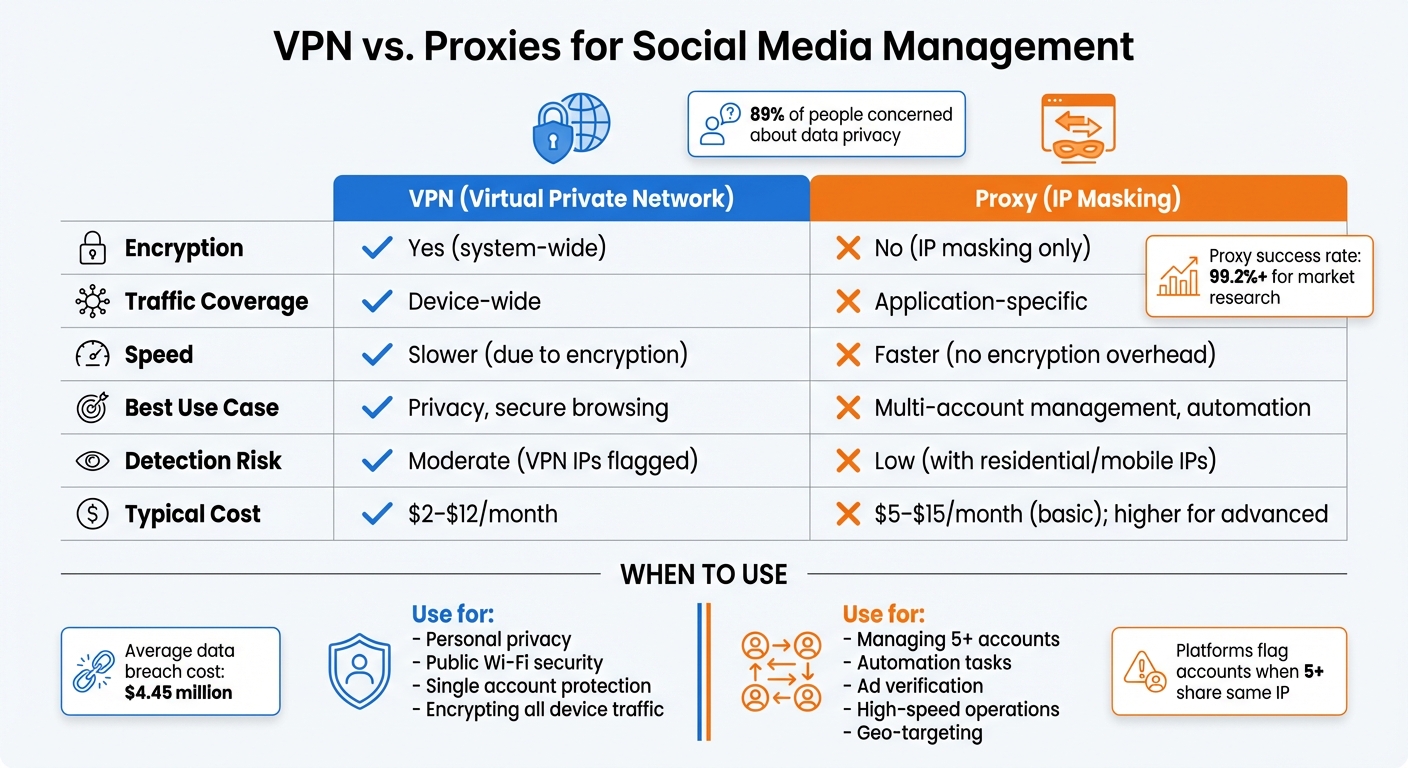
VPN vs Proxy Comparison for Social Media Management
The Difference Between a VPN and a Proxy Server
How VPNs Work
A VPN creates a secure connection - think of it as a private tunnel - between your device and a remote server, encrypting all the data you send and receive. This encryption works like sealing a letter inside an envelope, making your data unreadable to anyone trying to intercept it, whether they’re hackers, internet service providers (ISPs), or network administrators.
"A VPN creates an encrypted tunnel for your data, protects your online identity by hiding your IP address, and allows you to use public Wi‑Fi hotspots safely." – Kaspersky
VPNs function at the operating system level, meaning they encrypt all internet traffic from your device. This includes everything from social media apps and web browsers to background services running quietly in the background.
High-quality VPNs rely on AES-256 encryption, a gold standard for security, paired with advanced protocols like WireGuard and Lightway. These ensure not only strong protection but also fast performance. Features like Perfect Forward Secrecy add another layer of safety by generating a fresh encryption key for every session, so even if one key is compromised, your other data remains secure.
This level of encryption becomes especially crucial when using public Wi-Fi networks at places like cafes or airports. These networks are often unsecured, making it easy for attackers to intercept sensitive information, such as your social media login details. It’s no wonder that 89% of people in a survey expressed concern about their personal data being accessed or misused online. VPNs tackle this issue head-on by scrambling your traffic, rendering it useless to anyone attempting to eavesdrop.
Next, we’ll explore how proxies work and how their capabilities differ from VPNs.
How Proxies Work
A proxy server acts as a middleman for your internet traffic, replacing your real IP address with its own. This switch provides the anonymity needed to manage multiple social media accounts without raising red flags. Platforms only see the proxy server's IP and location, making it harder to trace multiple accounts back to a single user. This setup significantly lowers the chances of account bans. Let’s take a closer look at how proxies differ from VPNs in how they operate.
Unlike VPNs, which encrypt all traffic at the system level, proxies work at the application level. This means you can set them up for specific tools or browsers without affecting your entire device. For instance, you could use a proxy exclusively for managing Instagram accounts while keeping your personal browsing on a regular connection.
Here’s how it works: your device sends a request to the proxy server, which then forwards it to the platform using its own IP address. The platform responds to the proxy, which relays the reply back to you. This process ensures platforms can't easily link multiple accounts to one user, reducing the risk of penalties.
BirdProxies takes this functionality a step further by offering specialized solutions designed to meet the needs of social media users. For high-speed tasks like data scraping, they provide datacenter proxies, priced between $1 and $3 per IP per month. However, these proxies are easier to detect since they don’t originate from residential networks. On the other hand, residential proxies, which use real household IPs, boast success rates over 99%, making them perfect for managing multiple client accounts or verifying ads. For those needing a mix of speed and legitimacy, ISP proxies deliver datacenter-level speeds (100–300 Mbps) with the authenticity of residential IPs, making them a reliable choice for stable, long-term account management.
Main Differences Between VPNs and Proxies
The key distinction between VPNs and proxies lies in how they handle your data and where they operate. VPNs work at the operating system level, creating an encrypted tunnel that secures all online activities - whether you're browsing, using apps, or running background services. Proxies, on the other hand, operate at the application level, rerouting specific traffic without encryption. These differences directly affect performance and how easily they can be detected.
Because VPNs encrypt data, they can slow down your internet connection. Proxies, lacking encryption, are faster and better suited for tasks like managing multiple accounts or data scraping. As Manish Shivanandhan from freeCodeCamp puts it:
Proxies shine in automation and business scenarios... Social media managers use proxies to handle multiple accounts without triggering platform restrictions.
- Manish Shivanandhan, freeCodeCamp
Detection risks also differ. VPNs and datacenter proxies often use IP ranges that platforms can recognize, making them more likely to be flagged. In contrast, residential and mobile proxies are harder to detect, making them a safer choice for tasks like managing social media accounts.
Pricing reflects these differences as well. VPNs are generally more affordable, costing between $2 and $12 per month. Proxies, however, range from $5 to $15 monthly for basic use, with enterprise-level solutions costing thousands of dollars per month. The higher cost of proxies, especially residential ones, stems from the infrastructure required to maintain a rotating network of IPs.
Comparison Table: VPNs vs. Proxies
| Feature | VPN | Proxy |
|---|---|---|
| Encryption | Full end-to-end encryption | None (IP masking only) |
| Traffic Coverage | System-wide (OS level) | Application-specific (browser/app) |
| Speed | Slower (due to encryption) | Faster (no encryption overhead) |
| Security Level | High (protects against hackers) | Low (vulnerable to data interception) |
| Best Use Case | Privacy, secure remote work | Automation, scraping, account management |
| Detection Risk | Moderate (VPN IPs may be blocked) | High for datacenter; low for residential/mobile |
| Typical Cost | $2–$12/month | $5–$15/month (basic); $1,000+/month (enterprise) |
sbb-itb-ea6392c
VPN Pros and Cons for Social Media
VPNs play a crucial role in safeguarding sensitive social media data. With end-to-end encryption, they protect login credentials, customer information, and strategic plans from cyber threats. Considering that the average cost of a data breach is $4.45 million, this level of security is invaluable. As Charlie Osborne from ZDNET puts it, "VPNs provide a superior solution for personal security and privacy". Beyond just securing your browser, VPNs protect your entire device, ensuring that apps and background services remain safe - an essential feature for managing high-stakes social media operations.
The privacy advantages are equally noteworthy. Concealing your IP address reduces the risk of detection on social media platforms and prevents your internet service provider (ISP) from monitoring your online activities. This is particularly important when using public Wi-Fi at places like cafes or airports, where risks like man-in-the-middle attacks are common [15, 32]. VPNs also allow you to bypass geo-restrictions, granting access to region-specific content. For remote teams, they provide a secure way to share files and messages without compromising account security.
However, these benefits come with some downsides. One major drawback is that the encryption securing your data can slow down your internet connection. This can disrupt real-time engagement and make uploading large media files a challenge. Another issue is that platforms like Meta, X, and TikTok actively detect VPN usage. Hammond Pearce from UNSW's School of Computer Science and Engineering explains, "Popular, commercial VPNs often have 'known' endpoints, meaning the platform providers can tell if you're using one of those services". Using a single VPN IP to manage multiple accounts can trigger security measures, potentially leading to shadowbans or account suspensions.
The limited IP diversity of VPNs presents another challenge for managing multiple social media accounts. Unlike residential networks, VPN providers typically offer smaller IP pools, making it harder to rotate IP addresses effectively. Logging into several high-value accounts from the same VPN IP can raise red flags with social media platforms. Worse still, if a previous user of that VPN IP violated platform rules, the IP could already be blacklisted, impacting you before you even begin.
VPNs are excellent for securing sensitive financial data during ad spend management or ensuring safe connections on public networks [15, 32]. They're ideal when you need comprehensive device protection rather than just masking a single browser. However, for managing multiple social media accounts or handling high-speed automation tasks, the slower speeds and detection risks make VPNs a less practical choice.
Proxy Pros and Cons for Social Media
Proxies are a powerful tool for managing multiple social media accounts, thanks to their ability to assign unique IP addresses to each account. This unique IP isolation ensures accounts remain separate, which is critical because social platforms often flag connections when more than five accounts share the same IP address. Residential and mobile proxies, in particular, stand out by using IPs from real ISPs and cellular carriers. This makes automated actions appear more natural, mimicking genuine human behavior. As Adam Dubois, a proxy developer, explains:
"Residential proxies are IP addresses borrowed from real users' devices. They're the most popular choice for social media since they maintain an outstanding balance between quality and price".
Beyond account isolation, proxies also boost task performance. Rotating proxies, for instance, spread requests across multiple IPs, preventing errors like "Too Many Requests". For market research, they achieve an impressive success rate of over 99.2%, compared to less than 5% when using a single IP. Geo-targeting is another significant advantage, allowing users to access localized content and verify ads by leveraging IPs from specific regions. Mobile proxies take it a step further by utilizing CGNAT technology, where a single IP represents hundreds of users, reducing the risk of bans. Residential and ISP proxies are particularly effective, offering low detection rates and high trust scores.
However, proxies aren't without their drawbacks. Unlike VPNs, most proxies lack encryption, leaving your data exposed on unsecured networks. Free proxies are especially risky, as they often harvest user data or compromise login credentials. Another challenge is browser fingerprinting. Even with a clean IP, platforms can identify users through details like screen resolution, installed fonts, and WebRTC leaks. Geo-mismatches can also trigger security alerts. For example, logging into a U.S.-based account from a German IP might raise suspicion.
To optimize proxy usage for social media, follow these best practices:
- Stick to a strict 1:1 IP-to-account ratio.
- Match the proxy's location to the account's region (e.g., a New York IP for a New York-based account).
- Use sticky sessions that maintain the same IP for 10–30 minutes during active account management.
- Avoid datacenter proxies, as they are easily detected and can lead to account bans.
- Pair proxies with antidetect browsers like MultiLogin or GoLogin to mask browser fingerprints alongside the IP address.
Proxies excel in tasks like multi-account management, automation, and ad verification, especially when speed and scalability are critical. They enable the seamless handling of dozens - or even hundreds - of accounts without triggering platform security measures. With their combination of IP diversity, high trust scores, and reliable performance, proxies are a go-to solution for professional social media operations. BirdProxies' residential and ISP proxy networks, for example, provide the clean IPs and steady performance needed to manage these tasks at scale.
Comparison Table: Proxies for Social Media Tasks
| Task | Recommended Proxy Type | Key Advantage |
|---|---|---|
| Multi-Account Management | Static Residential (ISP) | Consistent identity with low detection risk |
| Automation (Likes/Follows) | Mobile or Rotating Residential | Mimics human behavior and avoids rate limits |
| Market Research/Scraping | Rotating Residential | 99.2%+ success rates and effective block bypassing |
| Ad Verification | Geo-targeted Residential | Accurate access to localized content |
| Mobile Platforms (Instagram/TikTok) | Mobile (4G/5G) | Highest trust level matching mobile traffic patterns |
When to Use VPNs vs. Proxies
Deciding between VPNs and proxies depends on your specific social media needs. If your goal is personal privacy - like securing your connection on public Wi-Fi or encrypting all your internet traffic - a VPN is a solid choice. For managing a single personal account with basic location masking, a VPN can handle the job. It works by routing all your device traffic through one shared IP.
On the other hand, proxies are better suited for more complex tasks, such as managing multiple accounts or performing automation. They allow for more detailed control, letting you assign unique IPs to different browser profiles at the same time.
If you're managing more than five accounts, using the same IP for all of them can trigger platform flags and lead to account bans. Services like BirdProxies offer ISP and residential proxies to address this issue by providing unique IPs for each account. This 1:1 ratio is essential for agencies managing numerous accounts, as it prevents accounts from being linked and banned.
Proxies also excel in automation. Tasks like scheduling posts, running campaigns, or collecting data can quickly hit rate limits when using a single IP. Rotating proxies solve this by spreading requests across thousands of IPs, making automated actions appear as organic traffic from multiple users. For instance, data collection with proxies can be up to 50 times faster compared to using a single IP.
Geographic targeting is another area where proxies shine. Say you're verifying a client’s Facebook ad in Dallas, Texas - you’ll need a Dallas-based residential IP to ensure your connection mimics that of a local user. BirdProxies' residential proxies offer city-level targeting with IPs from real ISPs, making this possible. For long-term account management, ISP proxies provide the reliability of a static IP combined with the trustworthiness of residential addresses.
Conclusion
Deciding between VPNs and proxies comes down to your goals for social media management. VPNs are excellent for personal privacy, encrypting all your device's traffic and keeping you safe on public Wi‑Fi. But when it comes to managing professional accounts, they fall short. Their shared and recycled IPs are quickly flagged by social platforms, and they lack the ability to assign unique identities to individual accounts - something essential for serious account management. This is why proxies are the go-to choice for handling multiple social media accounts effectively.
Proxies are purpose-built for this task. They operate at the application level, allowing you to assign a unique residential or mobile IP to each account. This prevents "linked bans", where platforms detect multiple accounts sharing the same connection and shut them all down. Services like BirdProxies provide the infrastructure professionals rely on, offering ISP proxies starting at $1.30 per IP per month and residential proxies from $4.25 per GB. These proxies use real household and mobile carrier IPs that social platforms trust, along with features like city-level targeting, sticky sessions for stable logins, and instant activation.
For those managing numerous accounts, running automation tools, or gathering market insights, proxies aren't just a better option - they're a necessity. BirdProxies makes scaling your operations simple and worry-free, eliminating the constant threat of bans, blocks, or platform flags that come with less effective solutions. Choosing the right tool ensures your social media management strategy remains secure, efficient, and ready to grow.
FAQs
What’s the difference between using a VPN and a proxy for managing social media accounts?
VPNs and proxies both help hide your IP address, but they function differently and cater to distinct needs in social media management.
A VPN encrypts all the internet traffic from your device and routes it through a secure server. This offers strong privacy, protects your data, and helps you bypass geo-restrictions. However, VPNs often assign a single shared IP address per connection, which can be an issue if you're managing multiple accounts. Using the same IP for different accounts might raise red flags and lead to account restrictions.
A proxy, in contrast, operates on a per-application level. It forwards specific requests and replaces your IP address without encrypting the data. This makes proxies faster and particularly useful for managing multiple accounts. With features like IP rotation, proxies ensure each account has a unique IP address, reducing the chances of bans or account suspensions.
To sum it up, go with a proxy for smooth multi-account management and lower latency. Opt for a VPN when your priority is security, encryption, or accessing restricted content.
Why are proxies often better than VPNs for managing multiple social media accounts?
Proxies are often the go-to solution for managing multiple social media accounts because they allow each account to operate with its own unique IP address. This separation is key to avoiding detection and preventing platforms from linking accounts, which can significantly reduce the chance of bans. By assigning a location-specific IP to each account, proxies enable seamless management of dozens - or even hundreds - of accounts without raising red flags on platform security systems.
Unlike VPNs, which route all traffic through a single connection, proxies work at the application level. This means they use less bandwidth, require fewer system resources, and can be applied to individual accounts or sessions. This setup ensures that each account looks like it’s being accessed by a separate, genuine user - an essential factor for maintaining security and staying under the radar.
How can proxies improve social media automation and account management?
Proxies act as a go-between for your internet connection, swapping out your real IP address for another one, often linked to a specific location. This substitution helps disguise your online activity, making it look like actions such as logging in, posting, or commenting are coming from various legitimate users instead of just one. As a result, proxies help you avoid IP-based blocks, CAPTCHAs, or account suspensions, making it easier to manage multiple accounts without interruptions.
Since proxies use IP addresses from actual internet service providers or mobile networks, they blend seamlessly with typical user traffic. This reduces the chances of automated actions - like scheduling posts, liking, or following - being flagged by social media platforms. Many proxies also have the ability to rotate IPs automatically, creating the appearance of natural browsing behavior and ensuring smooth, consistent sessions for tasks that run for extended periods.
Proxies also allow you to perform geo-targeted actions by selecting IPs from specific locations. This capability is particularly helpful for testing localized content, running ads tailored to certain regions, or bypassing location-based restrictions - all without needing to physically relocate your device. In short, proxies are a key tool for secure, efficient social media automation and managing multiple accounts effectively.