

Managing multiple social media accounts without proxies is risky. Platforms limit accounts per IP, and exceeding this can lead to social media IP bans. Proxies solve this by masking your IP, letting you run numerous accounts safely. The choice between residential and mobile proxies depends on your needs:
- Residential Proxies: Use IPs from home ISPs. They're stable, cost-effective ($1–$15/GB), and ideal for desktop platforms like Facebook or LinkedIn. They excel in geo-targeting and long sessions but have a moderate detection risk for aggressive automation.
- Mobile Proxies: Rely on IPs from 4G/5G networks. They're harder to detect, making them perfect for high-risk tasks on apps like Instagram and TikTok. They rotate IPs dynamically but are pricier ($10–$30/GB) and slightly slower.
Quick Comparison:
| Feature | Residential Proxies | Mobile Proxies |
|---|---|---|
| IP Source | Home ISPs | Mobile carriers (4G/5G) |
| Detection Risk | Low to moderate | Very low |
| Cost | $1–$15/GB | $10–$30/GB |
| Best Use | Desktop platforms, geo-tasks | Mobile apps, automation |
For desktop-heavy tasks, go with residential proxies. For mobile-first platforms or high-risk automation, mobile proxies are the safer bet.
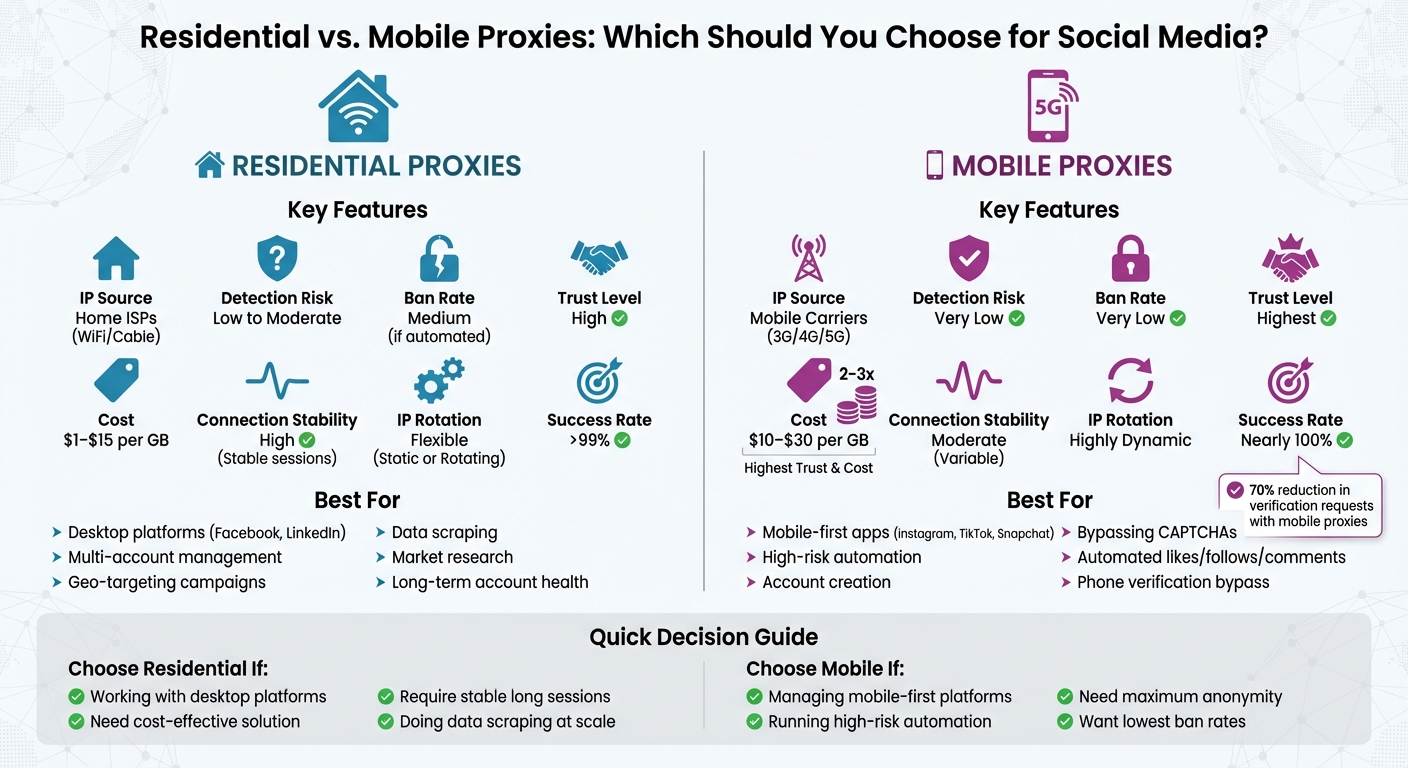
Residential vs Mobile Proxies Comparison for Social Media Management
What Is a Mobile Proxy? | Mobile Proxies Explained
Understanding how these work is crucial for social media automation with proxies to avoid account bans.
sbb-itb-ea6392c
What Are Residential Proxies?
Residential proxies are IP addresses provided by Internet Service Providers (ISPs) to real residential users and are linked to physical addresses. This setup makes your online activity appear as if it's coming from a genuine household connection, adding a layer of authenticity to your traffic. When you use a residential proxy, your connection is routed through a server with a legitimate residential IP - whether that’s from a home router, laptop, or another household device.
Social media platforms tend to trust residential proxies because they are tied to actual ISPs and carry a high level of credibility. Unlike datacenter proxies - which originate from cloud servers and are easier to detect - residential IPs are much harder to flag or block. Blocking them risks affecting real users, which platforms aim to avoid.
"Residential proxies act like real users. They help you stay hidden and keep your accounts safe." - Yilu Support
There are two main types of residential proxies. Static (ISP) proxies maintain the same IP address for longer periods, making them perfect for tasks like consistent account management. On the other hand, rotating proxies switch IP addresses periodically, which is ideal for high-volume activities like bulk account creation or data scraping.
Residential proxies are highly effective, achieving success rates of over 99% on social media platforms. Top providers offer access to over 72 million residential IPs spread across 195+ countries. This massive network allows users to manage accounts from virtually any location while maintaining the appearance of authentic local traffic.
Now that we’ve covered the basics, let’s dig into the key features that make residential proxies so dependable.
Main Features of Residential Proxies
Residential proxies are designed to seamlessly mimic regular household traffic. Each IP address is tied to a physical location and an actual device, making it incredibly difficult for platforms like Facebook or Instagram to detect them as proxies. This "real-IP" origin sets them apart from datacenter proxies, which are more easily flagged by anti-bot systems.
Their high trust scores are another standout feature. Since the IPs come from legitimate residential sources, platforms treat the traffic as genuine. Blocking these IPs could inadvertently affect real users, which is why websites are more cautious about restricting residential proxies compared to datacenter ones.
In terms of performance, residential proxies excel. They offer faster speeds and more stable connections over extended sessions, outperforming mobile proxies in many scenarios. They also maintain an impressive success rate of roughly 98.6% across various online tasks. Additionally, rotating proxies can significantly enhance data collection speeds - up to 50 times faster - by bypassing CAPTCHAs and other roadblocks.
Benefits of Residential Proxies
Residential proxies bring several advantages that are particularly useful for social media management.
One of their key benefits is the ability to overcome account limits. By assigning unique IP addresses to each account, they reduce the risk of suspensions and bans.
Another major perk is geo-targeting. Residential proxies let you view content and advertisements exactly as a local user would in a specific city or country. This capability is essential for verifying international ad campaigns and conducting localized market research.
"Residential proxies are powerful tools for social media marketing (SMM) that can help you achieve your goals and objectives." - Proxyma
They also excel at bypassing geo-restrictions, enabling safe automation and effective targeting. Whether you’re scheduling posts, scraping competitor data, or managing engagement, residential proxies provide the authenticity needed to stay under the radar.
What Are Mobile Proxies?
Mobile proxies work by routing your internet traffic through actual mobile devices connected to 3G, 4G, or 5G networks. These devices use IP addresses assigned by telecom providers like Verizon, T‑Mobile, and Vodafone.
One standout feature of mobile proxies is Carrier-Grade Network Address Translation (CG-NAT). This technology allows thousands of users to share a single public IP address, making your activity blend seamlessly with that of countless smartphone users. Because of this, platforms are far less likely to block these IPs.
Another important aspect is the way mobile proxies dynamically rotate IP addresses during each session. This constant change enhances anonymity and makes tracking your activity incredibly difficult. For apps like Instagram and TikTok, this behavior ensures that your actions appear natural and consistent with real user activity.
"Mobile proxies use real telecom IPs. This makes your actions look like normal user activity. You have less risk of bans or blocks when you use a proxy for social media." - Yilu Support
Mobile proxies are the priciest option, costing anywhere from $10 to $30 per GB. However, their ability to mimic genuine mobile traffic makes them the safest choice, especially for avoiding detection and bans.
Main Features of Mobile Proxies
What sets mobile proxies apart is their use of real mobile devices connected to cellular networks. Each IP address comes from an actual mobile device and rotates frequently, replicating the natural behavior of mobile users.
Mobile proxies also offer strong geo-targeting capabilities, enabling users to pick IPs from specific countries or cities. This is particularly useful for accessing location-specific content. However, one trade-off is that routing through cellular networks can result in slightly higher latency or slower speeds compared to datacenter proxies.
Benefits of Mobile Proxies
The biggest advantage of mobile proxies is their resistance to IP blocks. Social media platforms are hesitant to ban mobile IPs because doing so could disrupt thousands of legitimate smartphone users. This makes mobile proxies ideal for managing multiple accounts on strict platforms like Instagram, Facebook, and TikTok.
"Websites rarely block mobile IPs because they belong to real carrier networks. Blocking them would risk cutting off legitimate smartphone users, which companies want to avoid." - Yulia, Content Manager, Thordata
Another major benefit is enhanced anonymity. The combination of dynamic IP rotation and shared public addresses makes it nearly impossible for platforms to track your activity. Compared to other proxy types like residential or datacenter options, mobile proxies offer the lowest detection risk, ensuring your traffic looks just like that of a typical mobile user.
For tasks involving high-risk activities - like automation, bulk account creation, or managing multiple profiles - mobile proxies are a game-changer. They significantly reduce the chances of verification requests and account suspensions. While subscription plans can range from $50 to $80 per month, their reliable performance and low ban rates make them a worthwhile investment for serious social media managers.
Residential vs. Mobile Proxies: Main Differences
When deciding between residential and mobile proxies to manage multiple social media accounts, understanding their differences is essential. Both types route traffic through real consumer connections, but they vary in detection risk, cost, stability, and how they handle IP rotation.
Mobile proxies are incredibly hard to detect because of CG-NAT (Carrier-Grade Network Address Translation). This technology allows thousands of users to share a single IP address, making it nearly impossible to block without affecting legitimate users as well. On the other hand, residential proxies carry a low to moderate detection risk. Each IP usually represents a single household, which can make them easier to flag if used for heavy automation.
Cost is another key difference. Residential proxies typically range from $1 to $15 per GB, with bulk pricing dropping as low as $0.49 per GB. Mobile proxies, however, are more expensive, costing $10 to $30 per GB or $50 to $90 per month. This higher price reflects the infrastructure needed, such as SIM cards, mobile devices, and cellular network access.
When it comes to connection stability and IP rotation, residential proxies offer more stable "sticky" sessions or rotating IPs, making them great for tasks like web scraping. Mobile proxies, however, focus on dynamic rotation to mimic natural mobile usage, which enhances anonymity but can sometimes result in less stable connections.
"Mobile proxies are much better at dynamic IP rotation due to CG-NAT and provide a higher level of anonymity and resilience against detection."
Here’s a quick comparison to highlight the main distinctions:
Comparison Table: Residential vs. Mobile Proxies
| Feature | Residential Proxies | Mobile Proxies |
|---|---|---|
| IP Source | Home ISPs (WiFi/Cable) | Mobile Carriers (3G/4G/5G) |
| Detection Risk | Low to Moderate | Very Low |
| Ban Rate | Medium (if automated) | Very Low |
| Trust Level | High | Highest |
| Cost | $1–$15 per GB | $10–$30 per GB |
| Connection Stability | High (Stable sessions) | Moderate (Variable) |
| IP Rotation | Flexible (Static or Rotating) | Highly Dynamic |
| Best Social Media Use | Desktop management, LinkedIn | Instagram, TikTok, Account Creation |
| Success Rate | >99% when used correctly | Nearly 100% (minimal bans) |
This breakdown makes it clear which type of proxy might work best depending on your specific needs. Whether you prioritize cost, stability, or anonymity, each option has its strengths.
Best Uses for Residential Proxies in Social Media
Residential proxies bring unique advantages to the table, especially when navigating the complex world of social media management.
One of their standout benefits is the ability to manage multiple social media accounts without triggering platform security systems. Social networks like Facebook, LinkedIn, and Twitter treat traffic from residential IPs as authentic user activity, which makes them highly reliable for tasks that require discretion and stability.
Assigning a dedicated, stable IP to each account is another key feature. This prevents platforms from connecting multiple accounts to a single IP, a situation that often results in flagged activity or account bans. Most social networks start raising red flags when more than five accounts share the same IP address. For agencies managing client accounts or marketers juggling multiple brand profiles, this separation is vital to keep accounts safe and operational, often requiring a choice between residential vs ISP proxies for multi-account tasks.
Residential proxies also shine in geo-targeted campaigns. With access to over 72 million IPs across 195+ countries, you can create highly localized campaigns that resonate with specific regional audiences. For instance, using a residential IP from Dallas, Texas, enables you to verify local ad placements and ensure content aligns with the preferences of that area. This level of targeting can go as granular as specific states, cities, or even ISPs.
"Residential proxies are the gold standard for scraping ethically and effectively. Unlike free or data center proxies, they use real, ISP-assigned IPs, making your traffic look completely natural." - AJ Tait, IPBurger
LinkedIn automation is another area where residential proxies prove invaluable. LinkedIn closely monitors automation tools and tends to block non-residential IP ranges. Static residential proxies provide the stability and trustworthiness needed for tasks like outreach, profile management, and lead generation. Similarly, for platforms like Facebook and TikTok, maintaining consistent, authentic-looking sessions through residential proxies is essential to safeguard account health over time[2,6].
Next, we’ll dive into how mobile proxies can be leveraged for social media success.
Best Uses for Mobile Proxies in Social Media
Mobile proxies are a game-changer for mobile-first platforms like Instagram, TikTok, and Snapchat. These platforms are built with smartphones in mind, which means they naturally trust traffic coming from mobile carrier IPs more than other sources. By simulating genuine mobile traffic, automation tools can operate more smoothly, as the activity appears authentic to the platform. This makes mobile proxies a safer and more reliable choice for managing accounts on apps that prioritize mobile users.
They’re particularly effective for high-risk automation tasks. Whether it’s mass following or automated engagement campaigns, mobile proxies help reduce the risk of bans. This is largely thanks to how mobile carriers use Carrier-Grade NAT (CGNAT). With CGNAT, hundreds of real users share the same IP address, making it nearly impossible for platforms to block these IPs without affecting actual users.
"Mobile proxies are assigned by real telecom providers, making them virtually indistinguishable from normal users. This dramatically reduces bans, blocks, and verification loops." - HydraProxy
Another major benefit? Mobile proxies excel at bypassing CAPTCHAs and phone verification steps, achieving success rates of over 99% on major social platforms. For marketers running mobile ad verification campaigns, they provide an accurate view of ads as they appear on real mobile networks - essential for ensuring targeted campaigns reach the right audience.
To keep things running smoothly, it’s important to limit usage to 2–3 social media accounts per mobile IP and introduce human-like pauses between actions like following or unfollowing. Even with top-tier proxies, overly aggressive automation can still trigger detection systems if the behavior looks unnatural.
Performance Comparison for Social Media Tasks
Residential and mobile proxies offer distinct advantages when it comes to social media performance, each catering to specific needs. Residential proxies provide fast and stable connections, making them a great choice for tasks like managing multiple social media accounts or conducting market research. They boast success rates above 99% on most platforms. However, they can be more susceptible to detection when used for aggressive automation.
Mobile proxies, on the other hand, operate at slower speeds due to cellular network congestion but offer unmatched anonymity. Thanks to Carrier-Grade NAT, mobile IPs are shared among numerous real users, making it challenging for platforms like Instagram and TikTok to block them without disrupting legitimate users. As a result, mobile proxies shine in high-risk automation tasks, such as likes, follows, and comments, where detection could lead to account bans.
"Mobile proxy traffic is essentially undetectable due to the nature of cellular network architecture." - Khaled Bentoumi, Software Engineer, anyIP
Both proxy types perform well for account creation, though they excel in different ways. Residential proxies simulate activity from home users, while mobile proxies are better at bypassing the strictest detection systems on mobile-first apps. Pricing reflects their functionality: mobile proxies typically range from $10–$30 per GB, while residential proxies cost $1–$15 per GB.
Here’s a detailed breakdown of their performance across key social media tasks:
Performance Table: Social Media Tasks
| Task | Residential Proxies | Mobile Proxies | Best Choice |
|---|---|---|---|
| Account Creation | High success; mimics home users | Very high; ideal for mobile apps | Mobile for IG/TikTok |
| Automation (Likes/Follows) | Moderate; risk of rate limits | Very high; hardest to detect | Mobile |
| Ban Avoidance | Medium to high ban rate | Very low ban rate | Mobile |
| Connection Speed | Fast and stable | Moderate; higher latency | Residential |
| Multi-Account Management | High stability for long sessions | Very high; dynamic rotation | Mobile for apps |
| Data Scraping | Very high; cost-effective | High but expensive | Residential |
Each proxy type has its strengths, so choosing the right one depends on your specific social media goals. Whether you prioritize speed, anonymity, or cost, understanding these differences can help you make an informed decision.
When to Use Residential Proxies
Residential proxies are the go-to choice when you need reliable trust levels, extended session stability, and precise geo-targeting. They shine in tasks like managing high-value client accounts, running campaigns on desktop platforms, and collecting large amounts of data without setting off platform alarms.
These proxies are particularly useful for managing multiple client accounts at once. Agencies often assign a unique residential IP to each account, ensuring that each has its own digital footprint. This 1:1 ratio is now a standard practice to protect social media accounts from being linked and banned. Keep in mind that most social networks flag activity when more than five accounts share the same IP address.
Residential proxies are also excellent for geo-targeted tasks. For example, they allow you to verify how ads appear in specific cities or countries, giving you access to localized content and trends just as a local user would see them.
When it comes to web scraping and competitive analysis, residential proxies deliver impressive results. By using rotating residential proxies, you can achieve data collection success rates of over 99.2%, far surpassing the performance of a single IP. They’re particularly effective for gathering competitor insights, performing sentiment analysis, and monitoring trends. Since they mimic human behavior, they can bypass anti-bot systems that typically block datacenter IPs.
For those prioritizing long-term account health, private residential plans from providers like BirdProxies offer the stability and trust needed. These plans boast success rates exceeding 99% on major social platforms. To maximize these benefits, pair residential proxies with careful account warming - gradually increasing activity over time to establish natural behavior patterns.
When to Use Mobile Proxies
Mobile proxies are a smart choice for mobile-first apps that employ strict anti-bot measures. Platforms often assign greater trust to traffic coming from cellular networks like 4G and 5G, making these proxies especially effective for high-risk automation tasks such as automated following, liking, and commenting.
One major advantage of mobile proxies lies in their use of Carrier-Grade NAT (CG-NAT). With this technology, thousands of real users share a single public IP address. This setup makes it risky for social platforms to block these IPs, as doing so could unintentionally disrupt many legitimate users.
"Mobile proxies are by far the best option... I saw a 70% drop in verifications and nearly eliminated bans altogether." – HydraProxy
Mobile proxies are consistently reliable for tasks that require avoiding detection. Many users report a 70% reduction in verification requests after switching to mobile proxies, with success rates often exceeding 99% and minimal detection risk. They’re particularly useful for scraping mobile-specific APIs or testing how ads appear on real mobile networks across different regions.
However, mobile proxies aren’t without limitations. They tend to be more expensive and may experience higher latency due to cellular network constraints. Even with their high trust levels, it’s best to limit usage to 2–3 accounts per mobile IP and avoid overly aggressive automation patterns that could raise red flags. For desktop-heavy platforms like LinkedIn or large-scale data collection, different proxy types like residential proxies are often a more budget-friendly and practical option.
Conclusion
Selecting the right proxy depends on the specific needs of your social media tasks. Residential proxies strike a balance between reliability and affordability, making them a great choice for activities like large-scale data scraping, market research, and managing accounts on platforms like LinkedIn and Facebook. With success rates exceeding 98.6% and pricing ranging from $1 to $15 per GB, they are a dependable option for scenarios where stability and speed are crucial.
On the other hand, mobile proxies offer unmatched trust and minimal detection thanks to Carrier-Grade NAT technology. These proxies are ideal for high-risk automation on app-centric platforms like Instagram and TikTok. While they come with a higher price tag - typically between $10 and $30 per GB - their ability to avoid detection makes them indispensable for sensitive tasks.
"If you're scraping data, go with residential proxies. If you're automating social media, mobile proxies are the better option." – HydraProxy
A hybrid approach often works best: using mobile proxies for high-risk automation while relying on residential proxies for everyday account management can help optimize both security and costs.
BirdProxies offers tailored solutions for both residential and mobile proxy needs, specifically designed for professional social media management. With bandwidth-based plans starting at $5.00 per GB for residential proxies, quick activation, and an easy-to-use dashboard, BirdProxies allows you to scale your operations efficiently while maintaining the trust and reliability required to avoid bans or disruptions.
FAQs
What’s the difference between residential and mobile proxies for social media?
Residential and mobile proxies differ in how they source their IPs, how often those IPs change, and the tasks they're best suited for.
Residential proxies use IP addresses provided by home internet services, making them look like everyday household connections. Mobile proxies, meanwhile, pull their IPs from cellular networks, imitating traffic from actual smartphones.
One key difference is in how they handle IP rotation. Mobile proxies frequently switch IPs, which makes them highly anonymous and perfect for tasks like social media automation, managing multiple accounts, or avoiding bans. Residential proxies, however, offer more stable connections, making them ideal for tasks like geo-targeted scraping or consistent data collection.
If your focus is on maintaining high anonymity and avoiding bans during intensive social media activities, mobile proxies are your best bet. But for tasks that require steady, cost-efficient connections - like large-scale research or scraping - residential proxies are the smarter choice.
When is it better to use mobile proxies instead of residential proxies for social media?
Mobile proxies are the go-to choice when stealth and avoiding bans are top priorities, especially on platforms with strict anti-automation measures like Instagram, TikTok, and X. These proxies use IP addresses from actual mobile carriers (3G/4G/5G), making your activity look like it’s coming from a real mobile device. This setup greatly lowers the chances of triggering verification requests or account suspensions. Plus, with frequent IP rotation, they’re perfect for managing multiple accounts, automating large-scale actions, or handling tasks that imitate mobile app behavior.
They also shine when it comes to geo-specific mobile tasks, such as testing mobile ads or gathering data that’s only accessible to mobile users. That said, mobile proxies tend to cost more than residential proxies, so they’re best used when the added security and flexibility justify the higher price tag.
In summary, mobile proxies are ideal for high-risk platforms, mobile-focused tasks, or situations where reliability and uninterrupted performance are essential.
What are the benefits of using residential proxies for geo-targeting and managing multiple social media accounts?
Residential proxies use IP addresses linked to actual households, making your online activity look natural and trustworthy. Because these proxies are tied to specific locations, you can select IPs from any city in the U.S. or even from other countries. This is especially useful for testing location-based ads, accessing content tailored to specific regions, or managing posts without raising red flags due to sudden location changes.
Another advantage of residential proxies is the vast pool of unique IPs they offer. This is perfect for managing multiple social media accounts. By assigning a distinct residential IP to each account, platforms are less likely to group them together, reducing the chances of bans. This setup allows you to handle dozens - or even hundreds - of accounts at the same time. With their mix of reliability and scalability, residential proxies have become a go-to resource for social media professionals, influencers, and agencies.